
For a rising country like China with its sights set on global and regional power, any coming together of the US and India is the worst case scenario. Hence, China is concerned with the emerging equations between New Delhi and Washington, says Srikanth Kondapalli.

'At critical moments an inability to take tough decisions resulted in potentially far-reaching solutions slipping out of our grasp.' 'If similar opportunities come Narendra Modi's way will he act differently?' asks Karan Thapar.
'We are beginning to see that the rest of the world will not simply accept the domination of one power'
'A breakthrough in eastern Ladakh leading to disengagement and creation of a buffer zone will obviate the need of military deployment through the winter months ahead,' notes Ambassador M K Bhadrakumar.

China has chosen to keep New Delhi guessing, while retaining for itself the option of constantly changing facts on the ground and shifting the LAC westwards -- the strategy called 'salami slicing', notes Ajai Shukla.
Right from conducting nuclear deterrence patrols in 2015 to its destructive space programme, from its back-tracking on economic commitments to its hardened positions on Sino-India border deal -- its approach with India spells Adversarial with a capital A, says Shehzad Poonawalla

'The Ladakh clashes are mere warning signals of the storm to come on May 22 when the Chinese parliament meets,' observes Colonel Anil A Athale (retd).

Xi, the General Secretary of the Communist Party of China, called the progress China had made under his watch "truly remarkable
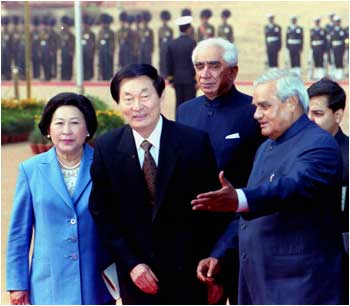
'He knew that a regime which believes that power flows from the barrel of the gun can only be handled from a position of comprehensive strength and not from a position of vulnerability and weakness,' says Rup Narayan Das.

Situated at a height of 15,200 feet above sea level, the pass sits on the top of a craggily formed Himalayan range that separates the Tibetan plateau from the Indian sub-continent.
'There is little doubt that China today stands in the dock, charged with misdemeanour with regard to the health and well-being of its own citizens and of the people of the world,' notes Amulya Ganguli.

It's time Rahul Gandhi became attuned to the reality of the 21st century instead of recycling failed political jargon of the 20th century,' argues Virendra Kapoor.

Xi ordered country's 2.3 million-strong military to be absolutely loyal to the party, to focus on how to win in wars, to pioneer reforms and innovation, to scientifically manage commanding a unit, to lead troops in accordance with the strictest standards and to take the forefront in complying with laws and regulations.

'At the previous 18th party congress, Xi vowed to protect China's 'core' interests.' 'As a result, India faced a barrage of serious incidents on the borders with China -- at Depsang, Chumar, Pangong Tso and Doklam.' 'New Delhi will watch closely the political signals emanating from Beijing this week,' says China expert Srikanth Kondapalli.

'The potential of one such LAC engagement going out of control and leading to heavy casualties cannot be ruled out,' warns Lieutenant General Syed Ata Hasnain (retd).

'India, he announced, is a "free, open, inclusive region" committed to the "common pursuit of progress and prosperity".' 'Prosperity yes. But free? Open?' 'Ask the Dalit tanner, the Muslim butcher, the Christian priest who writes pastoral letters.' 'Ask cattle traders of any religion or a Delhiwallah who enjoys a juicy steak.' 'Ask a Muslim who falls in love with a Hindu or vice versa,' says Sunanda K Datta-Ray.

China's major economic problem has been that its heartland is an agricultural region with about one-third of the arable land per person as the rest of the world.
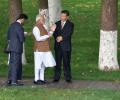
'The meeting marks the first tentative step in the effort to understand whether the two largest Asian nations can co-exist peacefully while realising their aspirations.' 'Caution and watchful wariness will dominate the effort of both sides,' says Jayadeva Ranade, former RA&W officer and China expert.
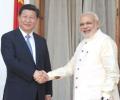
The summit is being seen as an effort by India and China to rebuild trust and improve ties that were hit by the 73-day-long Doklam standoff last year.

The meeting, which comes after the Doklam standoff, is aimed at a working a new paradigm for the bilateral relations for the next 15 years.
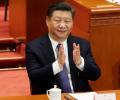
Xi, the most powerful leader in recent decades heading the ruling Communist Party and the military, will now be the first Chinese leader after the founder chairman Mao Zedong to remain in power lifelong.

'If the situation escalates, then mini-scale firing might happen.'

'Only when India's adversaries are convinced that India has both the necessary political and military will and the hardware to respond to a nuclear strike with punitive retaliation that will inflict unacceptable loss of human life and unprecedented material damage, will they be deterred,' says Brigadier Gurmeet Kanwal (retd).

'India need to look beyond the economic prism.' 'China had no qualms in taking the Kashmir issue to the UN Security Council last year -- not once, but thrice -- thus violating Indian sensitivities,' observes China expert Srikanth Kondapalli.

Indian Railways has to up investment to strengthen network just like China and Russia.

'That the two sides allowed such a situation to arise exposed the level of inaction and inefficiency in China-India border management.' 'The Modi-Xi meeting in Xiamen initiated a process to to avert such contingencies in the future.'
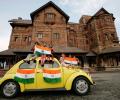
Though growth in China is unlikely to slow down soon, India should prepare to take advantage of a shifting of gears there.

'We may think that in our border quarrel, the Chinese can give up a bit of territory here or there to satisfy us, but that's not how they see it.' 'Arunachal Pradesh is 90,000 square kilometres and twice the size of Taiwan.' 'The Chinese can't be seen to be asserting their rights to Taiwan and on the other hand, cheaply giving up Arunachal Pradesh.'

After many false starts, India may well be at the inflexion point that Deng Xiaoping took China to post-1978. The window of opportunity is wide open right now, says Rajeev Srinivasan.

'Curiously, Pinarayi's approach, stressing the imperatives of development, is robustly backed by Nitin Gadkari.'
'I stand next only to Gadkari, one of the few outstanding ministers in the Modi government, in applauding Pinarayi's political courage and vision,' says Ambassador M K Bhadrakumar.

China's presence in the international dog house is just the kind of opportunity that his opponents must be waiting for, predicts Colonel Anil A Athale (retd).

The Chinese air force is now a 400,000-person force that flies some 2,000 combat aircraft -- more than thrice the size of the Indian Air Force.

In a rare gesture, China's official media in Beijing on Tuesday extended its biggest coverage to an Indian political event projecting Narendra Modi's takeover as Prime Minister as a harbinger of "big boost" to China-India relations.
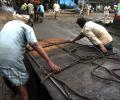
Manish Sabharwal is chairman of TeamLease, which has helped hire 1.4 million sales and customer service reps and logistics employees such as couriers for companies across India since it was founded in 2002.
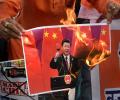
'And this mirror imaging is the most dangerous thing because it leads to tremendous misunderstandings.'

Why is China's supreme leader promoting Han Chauvinism so aggressively, asks Claude Arpi.
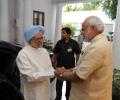
'If anyone is able to understand the importance of Modi's endeavours to revive the economy -- even against opposition from sections of his own saffron brotherhood -- it is the former prime minister,' says Amulya Ganguli.

India still has to go a long way to implement reforms in various sectors.

The Politburo Standing Committee -- the most powerful body in China -- is unveiled, but in a break from Communist party convention, no successor to Xi Jinping is named.

The American efforts to make India a security partner have enhanced India's importance to Chinese decision makers and new recognition of India's importance and achievements are reflected in a much more positive reporting about India in the State-controlled media, says Walter Andersen.
